
Hickory County Scheduled vs Actual Release
A projected date estimates when a person may leave a jail or prison under the current sentence calculation. Missouri records may instead use a precise term such as minimum release date, maximum release date, conditional release date, parole release date, scheduled release date, or presumptive parole release date. Keep that label. Each describes a different part of the sentence or decision process.
An actual release record documents what occurred. For Hickory County jail custody, ask for the recorded release date and time, release disposition, and receiving agency if the person was transferred. For state custody, use the MODOC release or discharge record. A court order explains legal authority but can precede the physical exit. A MOVANS status update can also lag the event or data entry.
Scheduled is not actual. A planned date can change. Only the custodian's release timestamp and disposition show that the custody event occurred and where the person went.
A pretrial detainee usually has no sentence-based release date. Bond action, a dismissal, a court order, a new hold, or transfer can determine what happens next. For that person, check the Hickory County court case and contact the sheriff rather than applying a prison sentence formula.
Find a Hickory County Projected Date
Start with custody type. The MODOC Offender Search is relevant only if MODOC has the person or still supervises the person. It covers active offenders and excludes discharged people. A Hickory County jail term that never resulted in MODOC commitment is calculated through the sheriff and sentencing court, not the state prison database.
- Match the person to the Hickory County court case. Read the judgment, sentence, bond entries, amended orders, and whether terms are concurrent or consecutive.
- Identify the present custodian. Ask the sheriff whether the person is in Hickory custody, boarded in another county, transferred, or committed to MODOC.
- For a state prisoner, search by DOC number when possible. Compare the name, sentence county, offense, status, and institution before relying on any displayed date.
- Record the date's exact label. If no release field appears, ask the institutional caseworker or parole staff rather than inventing a projected date from the sentence length.
- For a county-jail sentence, request the sheriff's computation and the court's judgment. Ask how certified jail-time credit was applied.
- Near the planned date, check for board changes, new orders, detainers, or receiving agencies. Verify the actual release after it happens.
The official active search warns that its information may not be current and does not include discharged offenders.
The current state entry point can be reviewed on the MODOC active-offender search form.
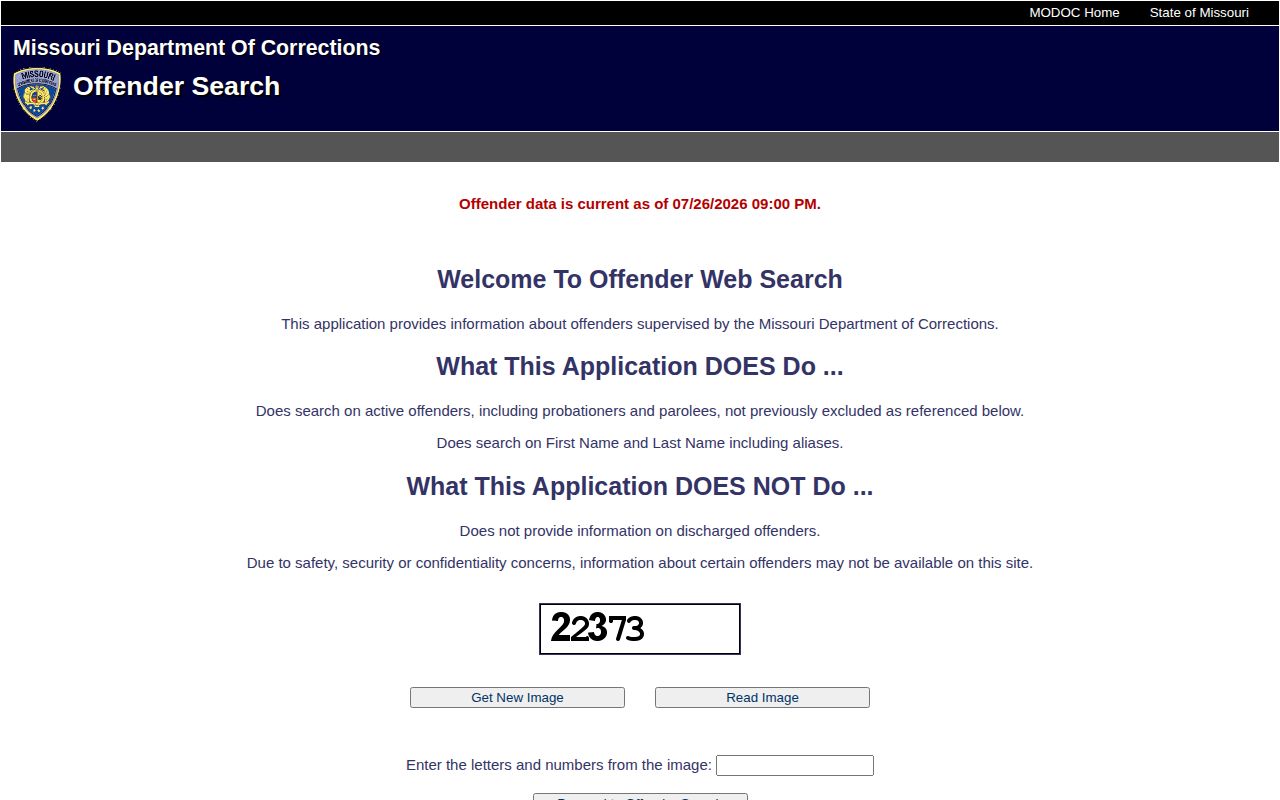
The capture shows the correct state starting point, but a public profile should not be assumed to display every internal sentence field.
Note: When a date is missing, MODOC directs person-specific questions to the institutional caseworker or assigned probation and parole officer.
Hickory County MODOC Release Fields
Missouri's nightly Sunshine offender file documents date fields more precisely than a generic “projected release” label. Sentence-I Minimum Release Date, field G0$PC, is the calculated minimum date for an active sentence. Sentence Maximum Release Date, field G0$PD, is the maximum or expiration date. Completed Flag, field G0$SCF, is marked Y when the sentence is complete.
| Official field | Meaning | Important limit |
|---|---|---|
| Sentence-I Minimum Release Date | Calculated minimum for an active sentence | Special codes can represent life, indeterminate or interstate status, or assessment |
| Sentence Maximum Release Date | Maximum or sentence-expiration date | It is not necessarily the expected community release date |
| Completed Flag | Y means the sentence is completed | Completion differs from the earlier date prison custody ended |
| Presumptive Parole Release Date | A tentative parole planning date | Conduct and an acceptable release plan remain conditions |
Special values in the sentence date fields include 99999999 for life, 88888888 for an indeterminate or interstate case, and 66666666 for assessment. These codes should not be reformatted as calendar dates. Ask MODOC what the code means for the specific record.
The MODOC Sunshine Law page and offender-file description explain the data and field layouts.
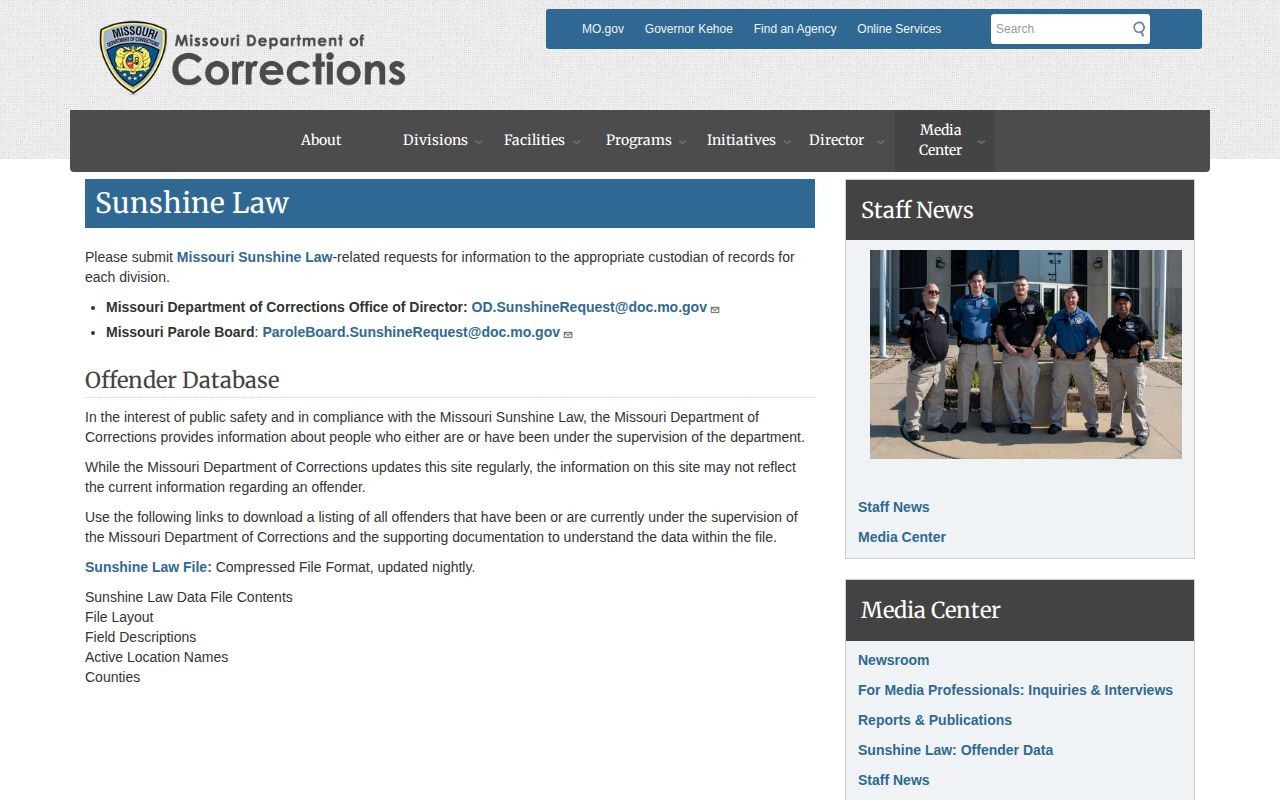
The nightly file is the state route for prior as well as current records, with agency cautions about conversion, completeness, and accuracy.
Hickory County Conditional Release Dates
For covered term-of-years felonies, RSMo § 558.011 divides the sentence between prison and conditional release. For a sentence of nine years or less, the conditional-release portion is one-third. For more than nine through fifteen years, it is three years. For more than fifteen years, it is five years. The prison portion is the remainder.
That framework has statutory exceptions. It should not be used as a stand-alone calculator. The judgment, offense classification, controlling statutory version, concurrent or consecutive terms, jail-time credit, Parole Board action, and current MODOC calculation all matter. Conditional release also remains supervision. It is not final discharge.
The Parole Board may extend a conditional-release date up to the full sentence after a violation and hearing under the statute. Parole guidelines can help explain general timing, but the guidelines do not guarantee a release. An official date for one Hickory County sentence must come from that person's current record.
Hickory County Good-Time Rules
Missouri does not promise every prisoner a fixed number of good-time days per month. Under RSMo § 558.041, an eligible person committed to MODOC may receive added confinement credit on a superintendent's recommendation. The policy rewards orderly conduct and participation in rehabilitative programs. Credits may be rescinded for rule or law violations, and statutory exclusions apply.
Earned compliance credits under RSMo § 217.703 are different. An eligible person on probation, parole, or conditional release may receive thirty days off the supervision term for each full compliant calendar month. Credits can pause during a violation, absconder, custody, or treatment-court period. They affect final discharge from community supervision, not the first date a person walks out of prison.
Avoid online arithmetic that combines these two rules. Prison confinement credit and community compliance credit govern different phases. MODOC's current calculation controls for a state sentence, while a Hickory County jail sentence requires the sheriff's own computation and the sentencing record.
Hickory County Eighty-Five-Percent Cases
Missouri's eighty-five-percent minimum is not a rule for every conviction. Under RSMo § 558.019.3, a person convicted of a dangerous felony as defined by statute generally must serve at least eighty-five percent of the court-imposed sentence, or until age seventy after serving at least forty percent, whichever occurs first. The section contains scope rules and exceptions.
Other qualifying listed offenses can carry minimum terms tied to prior MODOC prison commitments. One prior can trigger forty percent, two can trigger fifty percent, and three or more can trigger eighty percent under the detailed statute. The offense, criminal history, sentence, and governing version of the law must be checked.
Do not label every Hickory County sentence an eighty-five-percent case. A statutory minimum, a Parole Board guideline, and an actual release record are three different things.
Hickory County Jail-Time Credit
RSMo § 558.031 provides credit toward imprisonment for qualifying custody after the offense and before sentence, based on sheriff certification, for sentences within the current provision. That credit can affect a calculated date. Consecutive or concurrent sentences, amended judgments, escapes, detainers, and revocations can also change the total. Sheriff Greg Burke's Hickory County Sheriff's Office is the local custody contact.
For a sentence served only in the Hickory County jail, ask the sheriff for the computation and ask the Circuit Clerk for the judgment and amended orders. MODOC minimum and maximum fields do not control if MODOC never received the person. The Hickory County Circuit Clerk can provide the court-record path, while the sheriff confirms physical custody and the eventual exit time.
Reciprocal boarding adds another question. State audits document that Hickory County has housed outside prisoners and that surrounding counties have housed Hickory prisoners. Ask which facility held the person and which agency calculated the release. A move between custodians can look like release from one place without being release to the community.
Why Hickory County Release Dates Change
A release date is calculated from the records known at the time. A later order, credit correction, board decision, conduct finding, or hold can alter it. The cause should be checked with the agency that owns that part of the record.
| Change | Possible effect | Where to verify |
|---|---|---|
| Judgment or jail-credit correction | Minimum or maximum calculation moves | Sentencing court, sheriff, or MODOC |
| Consecutive sentence | Another term must be served in sequence | Judgment and current sentence record |
| Detainer or other hold | Person transfers instead of entering the community | Custodian release disposition and receiving agency |
| Conduct or credit loss | Expected confinement may extend | Institutional caseworker and MODOC calculation |
| Parole grant, denial, or deferral | A future date is set, moved, or not granted | Missouri Parole Board record |
| Release-plan decision | A presumptive date may change | Institutional parole staff |
| Revocation | Custody may resume and the term may be recalculated | Court or board action and MODOC |
Parole Board decisions ordinarily take eight to twelve weeks after a hearing. A hearing itself does not signal immediate release. The Board can set a date outside guideline ranges, and a home plan can be rejected. Ask for the current decision rather than relying on a prior estimate.
Hickory County Historical Release Dates
Missouri's historical state-record path differs sharply from its live search. The public active-offender search excludes discharged people. By contrast, the nightly Sunshine file includes current and prior offenders, documents minimum and maximum release-date fields, and carries a completed flag. A person missing from the active search may be discharged, may be mismatched, or may require a different record path.
Use the bulk file or a targeted MODOC request before declaring that a missing person was released. Supply the DOC number, full name, relevant date range, and the requested release, completion, or discharge fields. If the result conflicts with a more recent agency statement, reconcile the dates and data definitions.
This distinction is unique and useful for Hickory County state cases. It does not make the Sunshine file a county-jail archive. A person held only by the Hickory County sheriff remains a sheriff and court records question.
Confirm Hickory County Actual Release
Close the search by returning to the custodian. For the county jail, request the actual release date and time, disposition, and receiving agency. For MODOC, read the current status and obtain the release or discharge record when needed. If another county, federal authority, or immigration authority received the person, that recipient confirms continued custody.
The current Missouri notification portal can flag a scheduled or completed status change, but it is not a release certificate. Registration and current delivery rules are covered on the VINELink Inmate Search page. Keep the notice, then compare it with the agency record. Transfer and community release must stay separate.
Note: A release date answers “when” only after the disposition answers “what happened next.”
Public Record Search
Sponsored Results